




What Are Tax-Saving Bonds?
Tax-saving bonds are debt instruments issued by government and government-backed entities that provide specific tax benefits to investors.
Unlike regular bonds, these offer either tax-free interest income or tax exemptions on capital gains.
Currently, there are two main types of bonds that offer tax-saving benefits: Tax-Free Bonds (which offer complete interest tax exemption) and Sovereign Gold Bonds (which provide capital gains tax exemption if held to maturity).
Types of tax-saving bonds
Here are the different types of tax-saving bonds in India:
1. Tax-free bonds
The interest earned on tax-free bonds is exempted from income tax under Section 10(15) of the Income Tax Act, 1961. These bonds are issued by government-backed entities and provide a steady, tax-efficient income stream.
Tax-free bonds have an interest rate of 5-5.5% p.a. and a maturity period of 10-15 years. These are mainly issued by:
National Highway Authority of India (NHAI)
2. Sovereign gold bonds (SGBs)
Sovereign gold bonds are government-backed securities denominated in grams of gold. They offer an alternative to physical gold investment with additional tax benefits for long-term holders.
Capital gains for sovereign gold bonds are tax free if they are held till maturity (8 years). They offer an interest rate of 2.5% per annum on the nominal value (taxable).
3. Historical tax-saving bonds (Discontinued)
For reference, India previously had infrastructure bonds under Section 80CCF that provided tax deductions on principal investment. These offered a deduction of up to ₹20,000 on principal investment under Section 80CCF.
However, these bonds are no longer available.
Key features of tax-saving bonds
Investment options: Tax-free bonds (unlimited investment) and sovereign gold bonds (1 gram to 4 kg per year).
Lock-in period: 10-15 years for tax-free bonds, 8 years for sovereign gold bonds
Interest rate: 5-5.5% per annum for tax-free bonds (completely tax-free), 2.5% for SGBs (taxable).
What Are Capital Gain Bonds (54EC Bonds)?
Capital gain bonds help you save taxes on long-term capital gains earned from selling capital assets, such as land or building, held for over 24 months.
Let’s say you’ve just sold a piece of property, a plot of land, an apartment, or a house you’ve held for over two years. Now you’re looking at long-term capital gain. Yes, this is great news for your bank account but not-so-great news for your tax bill.
Capital Gain Bonds, also known as 54EC Bonds, help you avoid paying tax on long-term capital gains. But only from the sale of immovable property (like real estate, not stocks or mutual funds).
Key features of capital gain bonds
Issued by government-backed institutions: REC (Rural Electrification Corporation), PFC (Power Finance Corporation Limited), and IRFC (Indian Railway Finance Corporation). NHAI bonds are currently not available for new investments)
Investment limit: ₹50 lakh per financial year.
Lock-in period: 5 years (increased from 3 years in 2018).
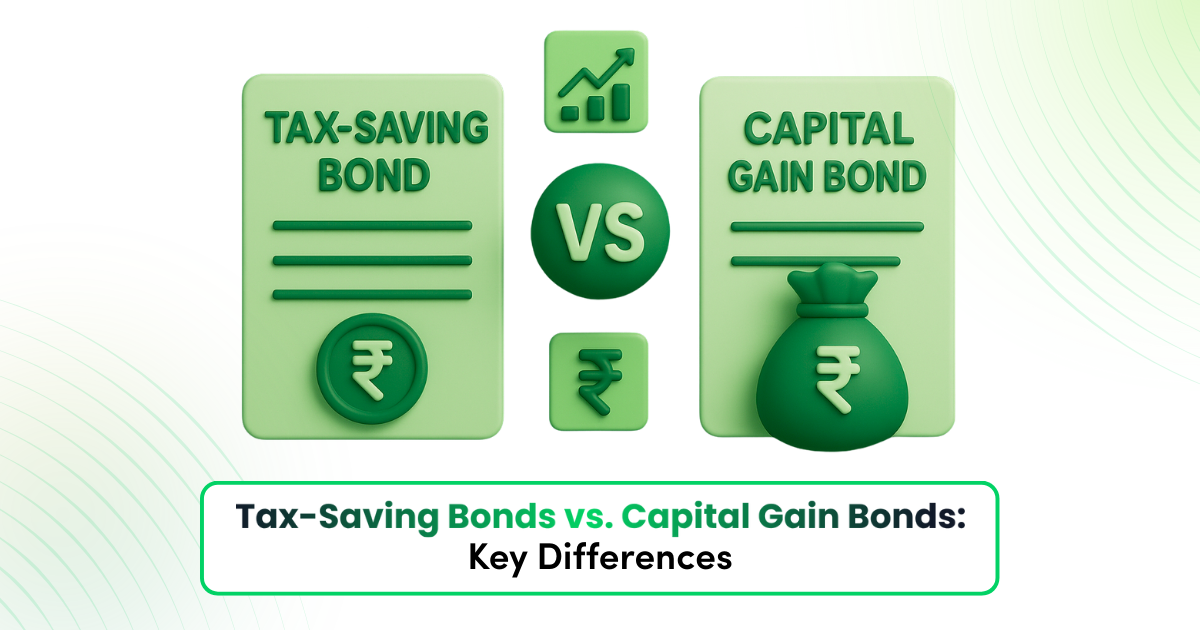
Key Differences Between Tax-Saving Bonds and 54EC Bonds
tax savings vs capital bonds table
Frequently Asked Questions
What are the key takeaways from this article?
Tax-saving bonds are debt instruments issued by government and government-backed entities that provide specific tax benefits to investors.
Who should read this article?
This article is designed for retail investors, first-time bond buyers, and anyone looking to understand fixed income investments in India.
How does this relate to my investment portfolio?
Understanding these concepts helps you make informed decisions about asset allocation and build a diversified investment portfolio.