




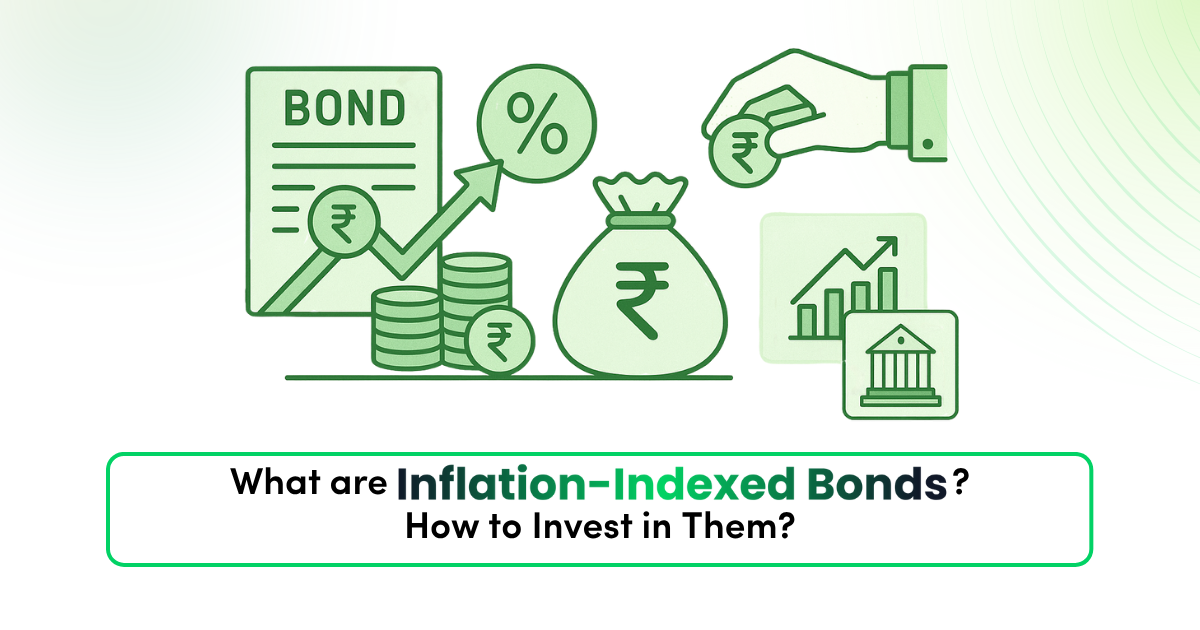
What Are Inflation-Indexed Bonds?
What Are Inflation-Indexed Bonds?
Inflation-Indexed Bonds (IIBs) are government securities where both the principal and interest payments are adjusted for inflation.
The adjustment is typically based on the Consumer Price Index (CPI). This means the real value of your investment is preserved, regardless of how inflation moves.
History of inflation-indexed bonds in India
India’s first experiment with inflation protection began in 1997, when the government launched its first Capital Indexed Bonds (CIBs). These early instruments protected only the principal amount from inflation, while interest payments remained fixed and vulnerable to price rises.
In June 2013. RBI introduced full-fledged Inflation-Indexed Bonds (IIBs). This new generation promised inflation protection for both principal and interest, with adjustments linked to the Wholesale Price Index (WPI), which was the key inflation metric at the time.
However, investors were wary of inflation-indexed bonds because of the following factors:
Types of Inflation-Indexed Bonds in India
1. Wholesale IIBs (2013 Series)
Launched by the RBI in June 2013 and are primarily target institutional investors.
Linked initially to the Wholesale Price Index (WPI). However, later discussions considered shifting to CPI for better relevance to retail investors.
Tenure: 10 years.
2. Inflation-indexed bonds for retail investors
Announced but never gained traction. Eventually, they were withdrawn due to poor response and lack of awareness.
Product structure for retail investors was under consideration but not finalised as of 2025.
How Inflation-Indexed Bonds Work in India?
Modern IIBs are designed to track the Consumer Price Index (CPI), which better reflects the inflation faced by households, compared to the broader WPI.
Here’s the structure and payout process for inflation-indexed bonds:
Fixed real coupon rate
When you invest in an inflation-indexed bond, you lock in a real interest rate that is paid on your principal. This rate is “real” because it’s over and above the inflation rate, not eroded by it.
Inflation-adjusted principal
The face value of your bond isn’t static. Each year, it’s adjusted upward (or downward) in line with the CPI. If inflation rises 4% in a year, your ₹10,000 principal becomes ₹10,400 for the next interest calculation.
Interest payments
It is calculated as the real coupon rate applied to the inflation-adjusted principal.
Suppose you purchase an inflation-indexed bond with:
CPI Inflation: 4% (as seen in early 2025, with RBI projecting 3.7% for FY 2025-26)
Frequently Asked Questions
What are the key takeaways from this article?
What Are Inflation-Indexed Bonds?
Who should read this article?
This article is designed for retail investors, first-time bond buyers, and anyone looking to understand fixed income investments in India.
How does this relate to my investment portfolio?
Understanding these concepts helps you make informed decisions about asset allocation and build a diversified investment portfolio.